Taiwan tea timeline
Two hundred years and more, from a single Wuyi seedling to importing twenty-four thousand tonnes a year.
In between: forty-six thousand hectares under tea at the peak, and a year when exports fell to twenty-eight tonnes. The best years of all were green tea years — almost nobody now remembers that Taiwan exported green tea.
- 1796?Date uncertainThe industry
Ke Chao brings Wuyi seed to Jiyukeng
Some time in the Jiaqing reign, Ke Chao carried tea seed over from Wuyi in Fujian and planted it at Jiyukeng — today’s Ruifang, in New Taipei. Tea growing in northern Taiwan starts here. The exact year did not survive; the sources say only “the Jiaqing reign”, which runs from 1796 to 1820.
- 1858The industry
The Treaty of Tianjin opens the ports
The Treaty of Tianjin named Taiwan-fu — today’s Tainan — a treaty port. Jardine Matheson promptly sent buyers over for rough-processed oolong. Taiwanese tea was on the international line for the first time, though still only as somebody else’s raw material.
- 1859The industry
Tamsui opens, and the leaf goes to Fuzhou
Tamsui was added as a treaty port. Taiwanese leaf went to Fuzhou to be refined and was exported from there, in growing quantity each year. The margin stayed in Fuzhou; Taiwan was paid for raw material — a structure only broken a decade later when Dodd set up refining at Bangka.
- 1865The industry
The first recorded export of Taiwanese tea
Tamsui customs logged over 82,000 kg of tea leaving that year — the earliest formal record of Taiwanese tea being exported, and it already included oolong from around Longtan, shipped down the Dahan river to the customs house. In the same years John Dodd surveyed the northern tea hills and brought in Anxi seedlings and Anxi makers, moving Taiwanese tea from rough processing to refined.

John Dodd, who brought Anxi seedlings and Anxi tea makers to northern Taiwan — the turn from rough processing to refined. - 1867The industry
Top of the export grades: Bai Hao oolong
Foreign trading houses sorted Taiwanese oolong into twenty-two grades, and the top one was “extra choice Bai Hao oolong” — the ancestor of what we now call Oriental Beauty. The same year Dodd trial-shipped his first refined oolong to Macau, and by 1869 it was sailing straight to New York, where “Formosa Oolong” started to mean something.
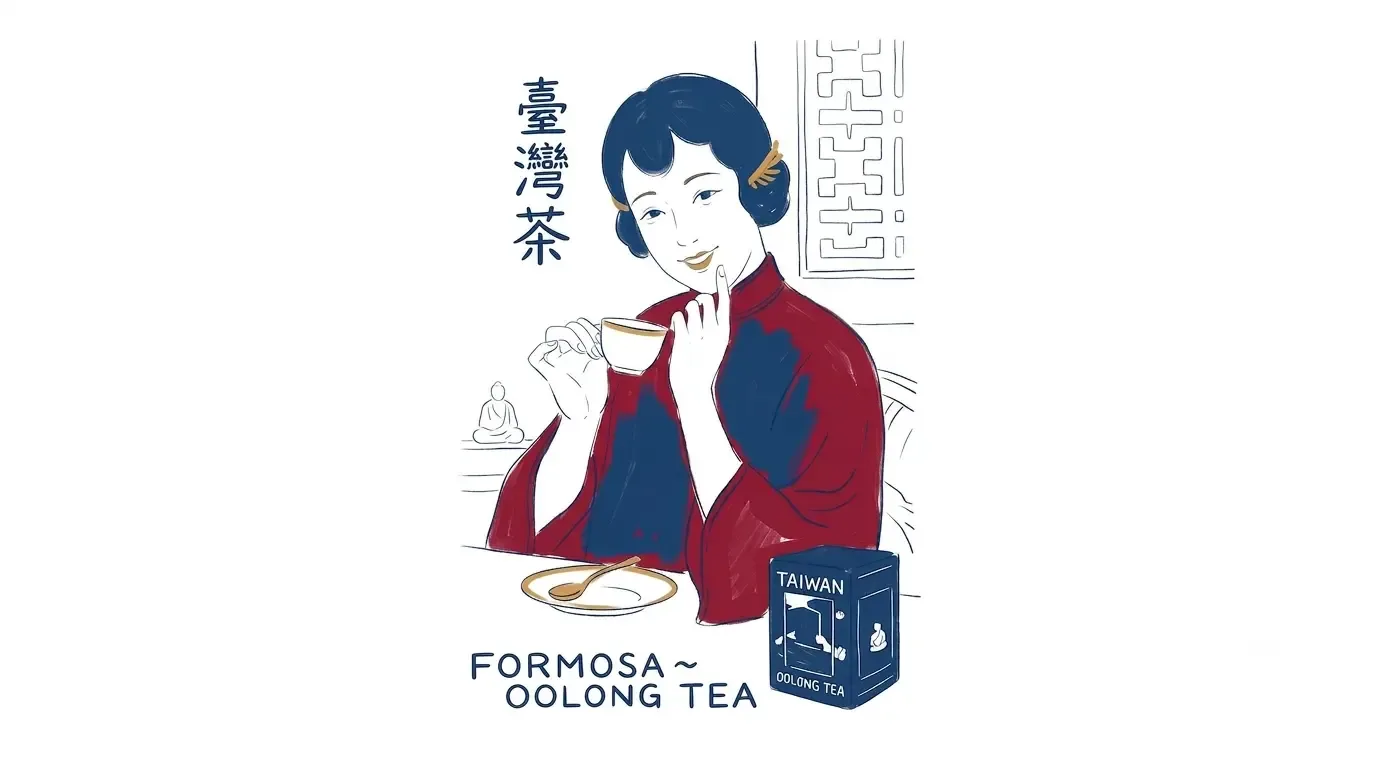
The “Formosa Oolong Tea” trade image — the name Taiwanese tea was sold under abroad. (Drawn for this page.) - 1869The industry
“Formosa Oolong” sails straight to New York
John Dodd shipped 2,130 piculs — 12,860 kg gross — of oolong direct to New York under the mark “Formosa Tea”. No Fuzhou, no borrowed name. This is the first time Taiwanese tea reached a shelf under its own name, and the shelf was American.
- 1874The industry
Chinese merchants take two fifths of exports
The Tamsui customs report noted that Chinese merchants now accounted for two fifths of all tea leaving the island. Fifteen years after the ports opened, the trade was no longer the foreign houses’ alone: local and mainland merchants had built their own channels.
- 1878The industry
The tea gardens spread into Taoyuan, Hsinchu and Miaoli
The customs report of that year put it bluntly: fifteen years earlier you could hardly find a tea bush on the slopes around Dadaocheng; now they were covered, right up to the frontier line. Planting had pushed south to the 24th parallel, close to central Taiwan, and Hsinchu had become a new producing region.
- 1880The industry
Oolong exports pass five million kilos
Oolong exports reached 5,248,533 kg. Against the 82,000 kg of 1865, that is sixty-four times in fifteen years. These are the years Dadaocheng became a tea street.

Dadaocheng, where the refining and the trading both happened — a whole street of tea houses by the wharf. (Drawn for this page; there are modern high-rises in it.) - 1881The industry
Pouchong starts going to Southeast Asia
Scented pouchong began selling into Southeast Asia; the following year 18,046 kg was formally exported. By 1894 the figure had grown fifty-six fold, making it the second largest export after oolong. Oolong went west, pouchong went south — from here Taiwanese tea had two legs to stand on.
- 1888The industry
Liu Ming-chuan brings in Assam technicians
Governor Liu Ming-chuan wanted a Taiwanese black tea and hired technicians from Assam to trial it. Output was tiny; the line would not really take until the Japanese period. The direction was right, though — forty-nine years later Taiwanese black tea was selling over 5.8 million kg a year.

Liu Ming-chuan, governor of Taiwan, who brought technicians from Assam to try making black tea. - 1893The industry
The Qing-era peak: 9,836 tonnes
Total tea exports came to 9,836 tonnes, the highest of the Qing period. Two years later the island changed hands, and the figure would not be beaten until well into the Japanese era.
- 1895The industry
Research institutions, and the base they laid
With the Japanese administration came planted gardens, research institutes for cultivation and for leaf processing, and subsidies for pest control and cultivar improvement. For the first time Taiwanese tea had long-term technical backing rather than merchants and growers each working it out alone.
- 1899The industry
Mitsui arrives: big gardens and modern factories
Mitsui opened large plantations at Haishan in Taipei and Daxi in Taoyuan, with modern factories to match — the origin of what would be sold as Nittoh black tea. A second mode of production had arrived: not only households with a few hillsides, but capital that owned the whole mountain.
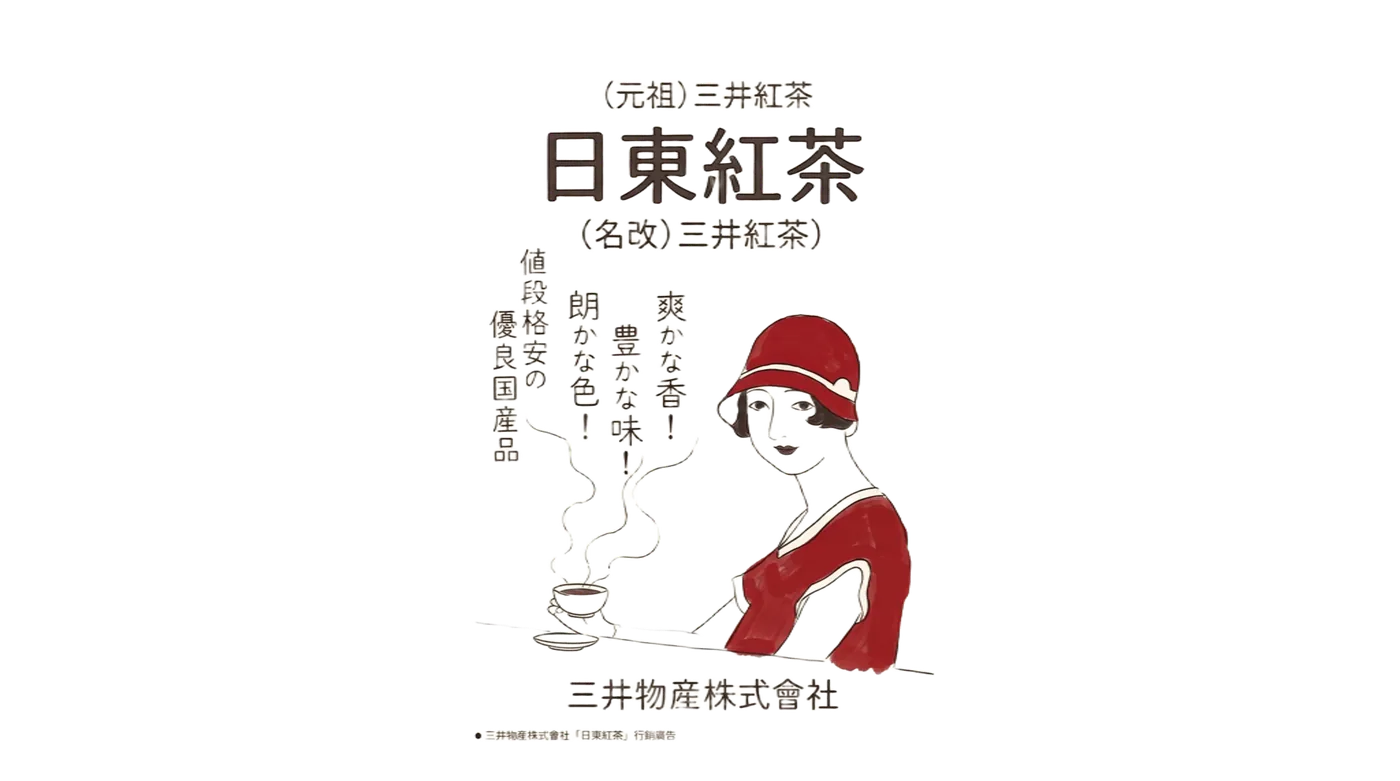
A Mitsui Bussan black-tea advertisement. Mitsui opened large gardens at Haishan and Daxi with modern factories; the brand that came out of it was Nittoh. (The advertisement itself is later than 1899.) - 1904The industry
Green tea goes into trial production for export
Taiwan began trial production of green tea for export. Four years earlier, in 1900, planted area stood at 26,620 hectares. A third product had joined oolong and pouchong — and half a century on it would become the island’s biggest tea business of all.
- 1905The industry
Black tea starts being made at Yangmei
The Japan-Taiwan Tea Company set up black tea manufacture at Yangmei. The country’s output began widening beyond oolong, and Taoyuan picked up a black tea line it has never entirely put down.
- 1908The industry
Anpingzhen turns to black tea; pouchong thrives
The Anpingzhen tea experiment station was lent to the Japan-Taiwan Tea Company to work solely on black tea. Three years later, in 1911, pouchong production around Wenshan and Qixing hit its stride. North for pouchong, Taoyuan and Hsinchu for black tea — the division of labour dates from here.
- 1919The industry
Two companies merge and black tea exports expand
The Japan-Taiwan Tea Company merged with the Taiwan Colonial Tea Company and pushed black tea exports together. Two years earlier, in 1917, planted area had reached 45,155 hectares — nearly 20,000 more than in 1900.
- 1920The industry
The oolong collapse: exports fall to 70,000 catties
A global downturn plus competition from Javan black tea knocked oolong exports down to 70,000 catties. The government bought up poor-grade leaf and tightened quality improvement. The first time Taiwan paid the price of betting on one product — it would happen again fifty-four years later.

The Office of the Governor-General. After the oolong collapse, the direction of the tea industry was decided here: back black tea, turn to pouchong. - 1928The industry
Pouchong turns to Manchuria and the northeast
As relations with China soured, oolong lost outlets — but pouchong found new ones as Manchukuo and the northeast opened up, holding annual sales around three million kilos through 1926–1930. One door closed on the market; the door that opened was political.
- 1933The industry
Peak planted area: 46,030 hectares
Planted area reached 46,030 hectares, the highest ever recorded. It has still not been beaten — today’s planted area is around forty-five per cent of it.
- 1936The industry
The Emei tea growers’ association is founded
The growers of Emei in Hsinchu organised. From here the district had a shared channel for selling and for quality control — the organisational groundwork for Emei later overtaking Beipu in planted area.
- 1937The industry
Three products stand together
“Taiwan black tea” came into its own, selling over 5.8 million kg a year and making a three-way contest with oolong and pouchong. Counting from Liu Ming-chuan’s Assam technicians in 1888, the line took forty-nine years to arrive.
- 1939The industry
War comes and the gardens are ploughed for food
Food shortages during the war saw tea gardens abandoned and replanted with crops. Exports in 1944 still came to 13,146 tonnes — 7,346 of pouchong, 5,800 of black. The 46,000 hectares of six years earlier never came back.

War turned tea gardens into grain fields. After this year tea was no longer a crop anyone could prioritise. - 1945The industry
Back to nothing: 28 tonnes exported in a year
At the end of the war planted area was down to 34,000 hectares and annual output to 1,400 tonnes — eight per cent of the Japanese-era peak. Exports: 28 tonnes. Fifty-two years earlier the figure was 9,836. This is the lowest point on the chart.
- 1949The industry
The green tea golden age opens
The year before had brought export exchange rules and currency reform; the American firm Hyeh Ho brought Shanghai green tea specialists over, set up in Hsinchu, and got it right — opening the golden age of green. Output climbed back past 10,000 tonnes. From 1,400 to 10,000 in four years.
- 1954The industry
A post-war high, then the peak years
Exports reached 14,800 tonnes, a post-war record. Five years on, in 1959, planted area was back to 48,000 hectares — more than the Japanese-era peak — and Taiwanese tea entered its fullest years.
- 1961The industry
Longtan makes steamed green tea for Japan
A factory at Longtan in Taoyuan went into steamed green tea made specifically for the Japanese market. The same district makes whatever the market asks for — which is also why Longtan could switch to *phòng-hong* tea later.
- 1968The industry
The Shakeng factory becomes the largest in the Far East
A record of scale at the height of the export era. Read it next to the entry seven years later: the biggest factory appeared, and then the whole industry turned.
- 1973The industry
The export high-water mark: 78 per cent green
Rough tea output topped 28,000 tonnes and exports 23,000 — the highest export figure in Taiwanese tea history, and 78 per cent of it was green. The best-selling year the island ever had was a green tea year. Almost nobody remembers that now.
- 1975The industry
The watershed: from export to the home market
Before 1975 Taiwanese tea was mostly for export; after it the home market took over, and by the 1980s the flip was complete. Domestically, competitions set the price — a top or first prize can multiply what a lot is worth several times over. Beipu built tourism around its old street and carried the tea’s name with it; Emei overtook Beipu in planted area from then on, and still leads.
- 1982The industry
The provincial tea manufacturing rules are repealed
With the controls lifted, making tea no longer had to follow one prescribed set of rules. Small growers could process and sell their own, and only then did the districts get complicated. Every producer-run garden you visit on a hillside today starts here.
- 1986The industry
Exports down to 10,000 tonnes; home market takes over
Exports fell to 10,000 tonnes, just 42 per cent of total output, and the industry formally became a domestic one. From 23,000 tonnes in 1973, more than half had gone in thirteen years. Exports were lost on price; the home market won on value — the same leaf simply sold for more at home.
- 1990The industry
A cross-district supply chain takes shape
Beipu and Emei divided the work: Emei supplied the leaf, Beipu did the selling. Planting spread to Toufen in Miaoli, Longtan in Taoyuan and Guanxi in Hsinchu, forming a cross-district chain. By now “origin” means a network.
- 1998The industry
The gardens move south and uphill
Planted area shrank to 20,658 hectares: 23,034 tonnes produced, 2,482 exported, 8,700 imported. The northern gardens contracted while high-mountain districts rose in Nantou, Chiayi and Yunlin. The idea that “Taiwanese tea means high-mountain tea” grew up here — before this it meant oolong, pouchong and green.
- 2006The industry
Imports run twelve times exports
Exports came to 2,031 tonnes, about 143 fewer than the year before, going mainly to the United States, mainland China, Hong Kong and Canada. Imports came to 24,319 tonnes, some 3,544 more than the year before, with Vietnam alone supplying 75.7 per cent. The tin on the shelf marked “Taiwanese tea” has a good chance of not being it — which is why this site records origin down to the township.