 Ruisui Honey-Scented Black Tea
Ruisui Honey-Scented Black Tea
Where to buy it
Flavour
Bitten by leafhoppers, yielding a rich honey aroma
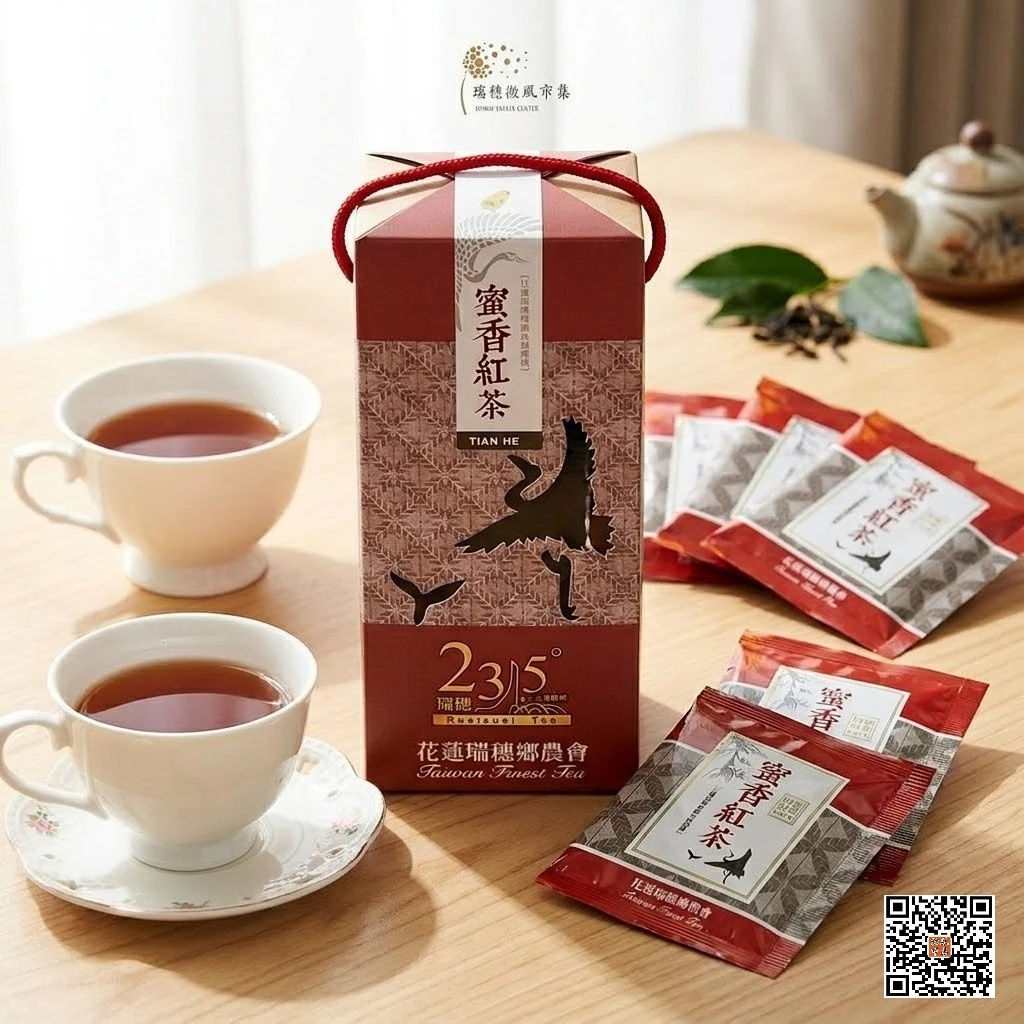
From 1990 the research station began experimenting with turning leafhopper-bitten shoots into black tea. In 2006 a honey-scented black tea made from Dayeh Oolong on the Wuhe terrace took the gold in the black tea class at the first National Tea Championship, and Hualien's honey black tea has held its place since.
The mechanism is the same as Oriental Beauty's: bitten leaf produces defensive aromatic compounds. Here it is taken all the way to a fully oxidised black tea.
So it too cannot be sprayed, is a summer crop only, and cannot be scaled up by better management.
⚠️ Pour at 95 °C and decant within three minutes. The honey note does not survive a long steep; overdo it and what is left is astringency.
Fair priceverified
One jin is 600 g. Below NT$800, be sceptical.
A reasonable range is NT$1,500–3,800 per 600 g. Below NT$800, ask more questions.
What to ask when buying this
Real honey aroma comes from insect bites and is summer-only. What you find in winter is usually old stock.
Hand-picking costs 1.5 to 3 times more. Check the spent leaves: hand-picked leaves are whole and uniform.
Spring and winter lots fetch the highest prices and the best aroma; summer and autumn are a step down in both.
If they will not let you taste but want you to buy 600 g of something expensive, walk away. It is the simplest and most effective filter there is.
Specifications
About the origin
In 1999 the tea station's Taitung branch ran trials on leaf that leafhoppers had fed on, and out of it came the honey-fragrance range: green, black and oolong. Keeping the leafhoppers means not spraying, so the branch encouraged growers to drop pesticides and move towards organic. The ecology came back, and so did the district's character. Ruisui in Hualien made the greatest success of honey-fragrance black tea, now over 25,000 catties a year and past a hundred million yuan in value. **You cannot order it up** — no insect, no honey.
The person who made it Ruisui's signature was Gao Zhao-xu, a grower in Wuhe. Around 2000 he worked the method out with the Taitung branch of the tea research station, and in 2006 he took gold in the black tea class at a world tea championship. In 2010 Nian A-duan won four golds at an international contest held in Taiwan, and that was when Ruisui was properly noticed. The local farmers' association has spent years pushing chemical-free growing, for one reason: leafhoppers only stay in gardens that are never sprayed.
These figures will be updated if they change.
Brewing
Why this temperature
Black tea is fully oxidised: its polyphenols were already converted during processing, so it takes heat well but does not carry ten steeps the way oolong does. Pour it off within three minutes; longer and the grip turns to astringency. For milk tea, use half again as much leaf rather than a longer steep, which only draws out bitterness.
Temperatures follow the official category guidance. Source: TRES — Effects of water quality and temperature on tea liquor
Common mistakes with this tea
90°C or above. Too cool and the roast aroma never opens, leaving it flat.
Best drunk within two months.
The most common beginner regret is buying 600 g on the first try. Buy a jin only after you know you like it.
What to eat with it
A dense, creamy sweet needs a tea with comparable body. A light fragrant tea reads as thin beside it.
This one is Taiwan-only — not available overseas
Here are the closest teas we can actually ship you:
Yuchi Sun Moon Lake Black TeaYuchi 700 m Mint Cinnamon1.0–2.2kLocation accuracy: township level (23.4970, 121.3750). This marks the growing area, not one specific garden.
East Rift Valley Tea Region3
What there is to do here
3 routes Two days possible Ruisui, Hualien: Wuhe・Yuli, Hualien: Chikeshan・Fuli, Hualien: Liushishishan
Chike mountain and Liushishi mountain, where daylilies and tea grow on the same slopes. August’s gold is the famous picture, but the tea is here all year.