 Yuchi Sun Moon Lake Black Tea
Yuchi Sun Moon Lake Black Tea
Where to buy it
Flavour
Mint and cinnamon aromas with layered complexity
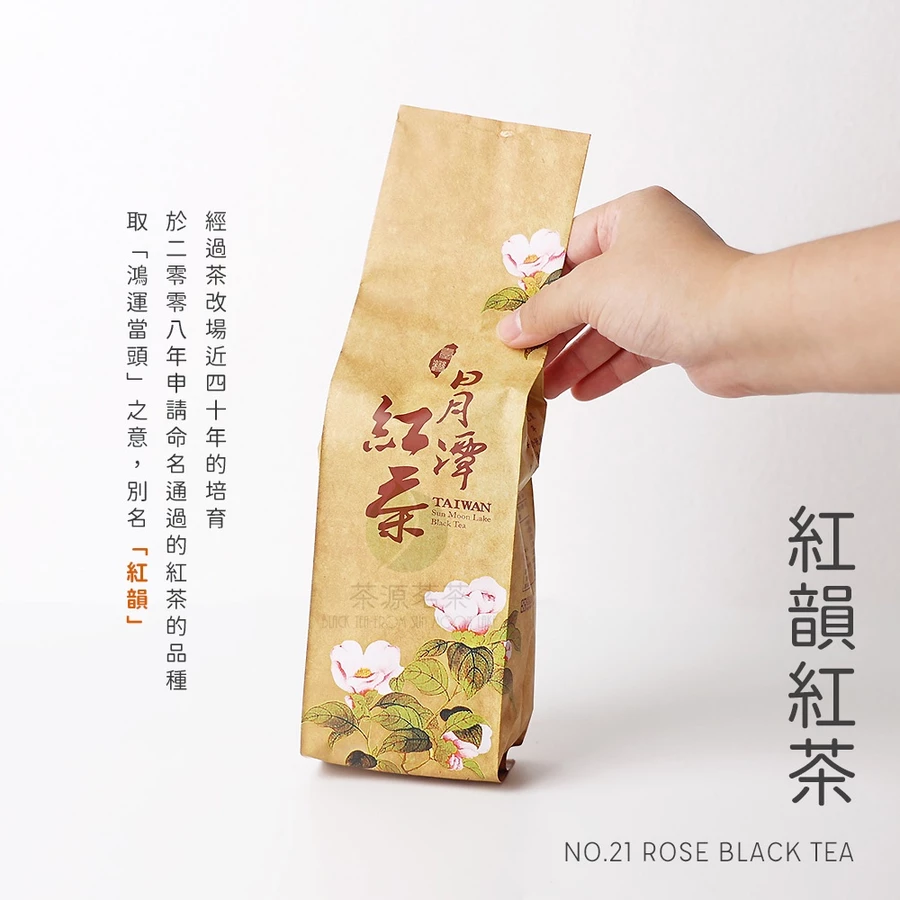
TTES No. 18. One parent is a Burmese large-leaf tea, the other is Taiwan's own wild mountain tea — and the cool mint-and-cinnamon note comes from the second.
Fully oxidised, around ninety-five per cent, but it does not behave like an ordinary black tea: strong grip without astringency, and a bright red liquor.
Assam stock was brought from India and trialled at Yuchi in 1925; Ruby was only released in 1999. Seventy-four years between the two.
⚠️ Do not boil it. Pour at 95 °C and decant inside three minutes — steep it longer and bitterness buries the cool note.
Fair priceverified
One jin is 600 g. Below NT$600, be sceptical.
A reasonable range is NT$1,000–2,200 per 600 g. Below NT$600, ask more questions.
What to ask when buying this
Hand-picking costs 1.5 to 3 times more. Check the spent leaves: hand-picked leaves are whole and uniform.
Spring and winter lots fetch the highest prices and the best aroma; summer and autumn are a step down in both.
If they will not let you taste but want you to buy 600 g of something expensive, walk away. It is the simplest and most effective filter there is.
A scannable producer record beats any verbal assurance.
Specifications
About the origin
The Zhuluo county gazetteer records that in 1717 there was "much tea" in the inner hills of Shuishalian, but the road was dangerous and the Han settlers dared not go in to pick it — tea in Nantou goes back a long way. What made Sun Moon Lake black tea known was the Japanese. In 1916 a tea technician tried making black tea from wild bushes at Yuchi and found the soil and climate suited; in December 1925 large-leaf Assam stock was brought from India and first trialled at Lianhuachi, which averages 20 °C and 2,900 mm of rain a year under near-permanent cloud — much like Assam itself. The peak year was 1966: 1,815 hectares, over ninety per cent of Taiwan's black tea, almost all of it exported. Nantou's county magistrate Liu Yu-you gave it the name Sun Moon Lake black tea in 1977. Cheap imports from Southeast Asia and then the 1999 earthquake brought the industry down.
These figures will be updated if they change.
Brewing
Why this temperature
Black tea is fully oxidised: its polyphenols were already converted during processing, so it takes heat well but does not carry ten steeps the way oolong does. Pour it off within three minutes; longer and the grip turns to astringency. For milk tea, use half again as much leaf rather than a longer steep, which only draws out bitterness.
Temperatures follow the official category guidance. Source: TRES — Effects of water quality and temperature on tea liquor
Common mistakes with this tea
90°C or above. Too cool and the roast aroma never opens, leaving it flat.
Best drunk within two months.
The most common beginner regret is buying 600 g on the first try. Buy a jin only after you know you like it.
What to eat with it
A dense, creamy sweet needs a tea with comparable body. A light fragrant tea reads as thin beside it.
Location accuracy: township level (23.8950, 120.9260). This marks the growing area, not one specific garden.
Nantou Tea Region4
What there is to do here
6 routes Two days possible Lugu・Mingjian / Songboling・Zhushan・Yuchi・Shuili・Nantou City: Houtanjing
Dongding is in Lugu, Songboling in Mingjian, the spiral gardens in Zhushan, and Sun Moon Lake black tea in Yuchi. Four places making four different teas, all within an hour of each other by car — the densest square of tea in Taiwan.